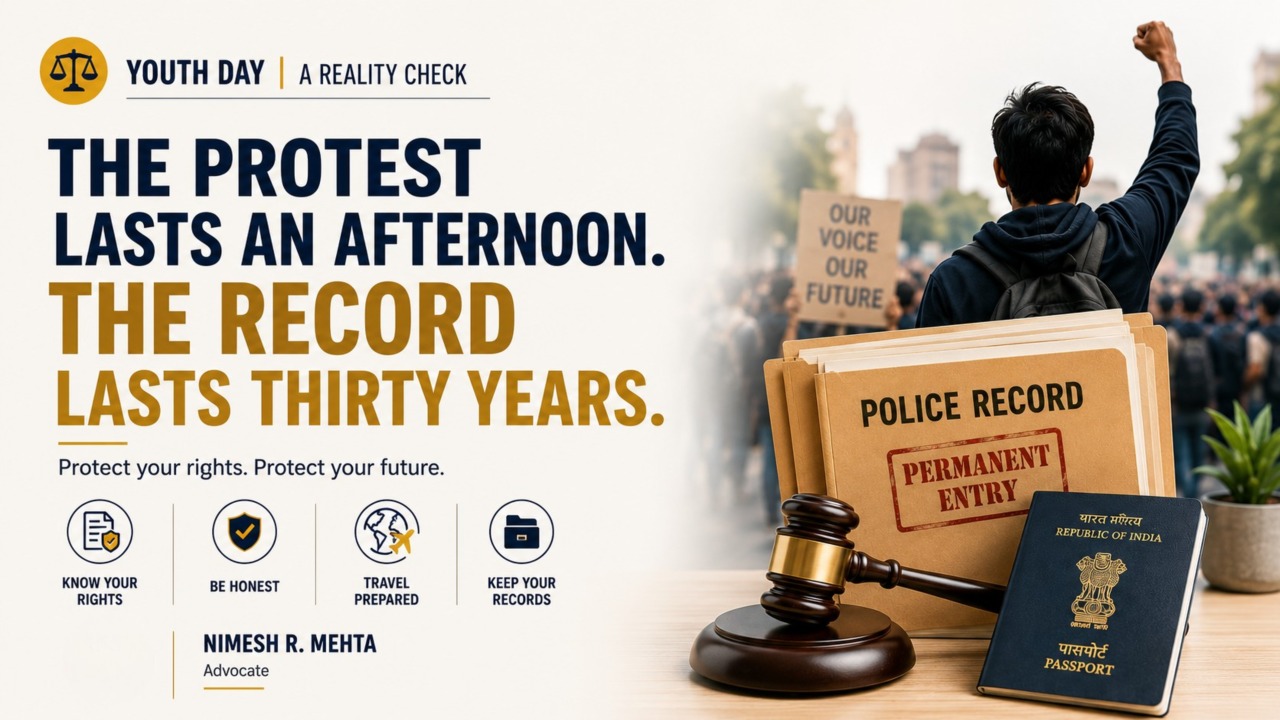
Legal consequences of arrests during protests, and what they do to careers and travel
Let me say the important thing first, because too many articles like this begin by scaring you into silence.
Speaking up is not a mistake. Every right you enjoy today — to study where you want, to work where you want, to say what you think — exists because someone your age once stood in a street and refused to be quiet. The Constitution does not merely tolerate that instinct. It protects it. Article 19 gives you the freedom to speak and the freedom to assemble peacefully. Those are your rights, not a favour granted to you.
So this is not an article telling you to stay home. It is an article telling you how to come home in one piece — with your voice, your degree, your job offer and your passport still intact.
What actually happens when the police pick you up
Most students imagine a dramatic trial. That is almost never how it goes.
Usually the charges are small ones — blocking a road, joining a crowd after an order banning gatherings, pushing against a barricade. They carry a fine or a few months at most. Very often nothing goes to court at all: you are held for a few hours, made to sign a paper, and sent home by evening.
And that is exactly where the trap is.
You walk out thinking nothing happened. But something did. The moment your name is written into a police register, it enters a national computer system that every verifying authority in the country can search. Not for a year. For decades. Long after the protest is forgotten, the entry is still sitting there, quietly waiting for the day you apply for something that matters.
Getting released is not the same as being cleared. Nobody tells you that at the police station.
Even winning the case doesn’t wipe the slate
Here is the part that surprises people. Suppose the case goes to court and you are cleared completely. Wonderful — but India has no law that deletes the original entry. The case is over; the record is not. It shows up in police verification, in employer background checks, in the forms you sign for years afterwards.
This is why the paperwork matters more than the courtroom drama. If you are ever detained — even for two hours — ask for a copy of everything you sign, and keep it. If a case ends, get the court’s final order in writing and keep it forever. That thin sheet of paper is what turns “there is something on this candidate” into “this was a peaceful protest, here is the order closing it.” Same facts. Completely different outcome.
The one mistake that ruins more careers than any protest
If you take away only one line from this article, take this one.
Government job forms, defence and police forms, many private company forms, and every serious visa form ask some version of: have you ever been arrested, detained or prosecuted?
Students see that and think: I was let out the same night, no case was filed, this doesn’t count. They tick “No.”
It counts. And ticking “No” is what destroys them — not the protest.
The Supreme Court has been very clear about this. Hiding the information is treated as a wrong in itself, separate from whatever happened at the protest. Employers routinely forgive a disclosed protest case. They almost never forgive a hidden one, because now the question is not your politics — it is your honesty.
Tell the truth, attach the papers, and you will usually be fine. Hide it, and you usually will not be.
About travel — the part nobody warns you about
This is the consequence that hits Gen Z hardest, because so many of you are planning a master’s abroad or a job overseas.
- Your Indian passport. If a case is still running in court, your passport can be held up. There is a workaround — the court can permit you to travel — but it means an application, a hearing and a wait of several weeks, every single time you want to fly. Imagine that landing in the middle of your admission deadline.
- United States. The visa form asks whether you were ever arrested. Ever means ever — even if the case was closed, even if you were let off. Answering honestly is usually survivable. Being caught hiding it is treated as lying to the US government, and that follows you for life.
- Canada, UK, Australia, Europe. All of them ask, all of them check. Student visas get checked far more strictly than tourist visas — which means students face the tightest scrutiny of anyone.
None of this makes travel impossible. It makes it slower, more expensive and more anxious — unless you have your documents ready.
Ten minutes of admin that protects ten years of your life
- Keep a copy of every paper you are asked to sign. Ask politely; you are entitled to it.
- Get the final court order if a case is filed, and store a scan in the cloud.
- Never tick “No” on a disclosure form to make life easier today.
- Save a lawyer’s number in your phone before you go, not after.
- Tell one person at home where you are. Not for permission — for backup.
- Stay on the peaceful side of the line. The moment stones fly, the law stops treating it as speech.
Being brave and being careless are not the same thing
There is a myth going around that caution is cowardice — that if you truly cared, you would not think about consequences. That is nonsense, and it is usually repeated by people who have nothing at stake.
The students who changed this country were not reckless. They were organised. They kept records, briefed lawyers, learnt the rules, and stayed peaceful precisely because they intended to still be standing years later. Courage without care burns out in one afternoon. Courage with care becomes a career, an institution, a change in the law.
Your generation has something no previous one had: a phone that can document everything, and a network that can amplify it. Use it properly. The video that protects you from a false allegation is worth more than the video that gets the most views.
And understand what you are really protecting. You are not protecting a job. You are protecting your capacity to keep fighting. The lawyer who argues a case, the officer who reforms a department, the journalist with a visa, the founder who can raise money — each of them needed a clean file to get into the room where things actually change. Do not lose the room for the sake of one afternoon.
Go. Speak. Stand up for what you believe. Just carry your papers home with you — because the protest lasts an afternoon, and the record lasts thirty years.
General guidance for students, not advice on any individual case. If you are actually facing a case, speak to a lawyer with the papers in hand.